Your passport to the cruise industry.
“Every mandatory certificate.
One streamlined package.”
Get internationally recognised qualifications, hands-on training and job placement support to work on cruise ships, worldwide.
Accreditations: Highfield, SAMSA, STCW • Internationally Recognised • Job-Ready in 2 Weeks
Cruise Career Launcher – Package
Your Journey. Your Growth. Your Future at Sea
Why This Career?
Industry Gap
The global cruise industry carries 30+ million passengers annually and employs over 400,000 crew. South Africans are increasingly sought after, but only with complete STCW and security certification.
The Crossover Advantage
This package covers every non-negotiable requirement for cruise line employment: safety, security, crowd management, crisis management, and food safety. One provider. One certificate run. Zero gaps.
The Lifestyle
Travel the world on floating cities. Visit multiple countries per month. Earn in hard currency with all living expenses covered. Build a career that can take you to Steward/ess / Housekeeping /Laundry/and others.
Security
Major cruise lines (MSC, Royal Caribbean, Norwegian, Carnival) have rigorous hiring standards. This package ensures you meet every single one from day one.
Work.
Travel.
Earn.
Grow.
Your Adventure Starts Here.
Included in this career package
The training required by various industries and ships can vary depending on the type of ship, the position you’re applying for, and the company’s specific requirements. Make sure you enrol for the correct courses:
We recommend first checking with your recruitment agent or the company to confirm exactly which STCW certificates are required for your role. This will help ensure that you complete the appropriate training and avoid paying for any courses that may not be necessary.
From training to your first pay-cheque at sea. We guide you every step of the way.
Course 1
Fire Prevention and Fire Fighting A-VI/1-2 (3 Days)
Course 2
Personal Safety and Social Responsibilities A-VI/1-4 (2 Days)
Course 3
Personal Survival Techniques A-VI/1-1 (2 Days)
Course 4 (Selection)
Medical First Aid (Including Elementary First Aid) STCW A-VI/4-1 & STCW A-VI/1-3 (4 Days)
OR
Elementary First Aid STCW A-VI/1-3 (2 Days)
Course 5
Passenger Ship Crowd Management – STCW A-V/2, para 1 & 2 (1 Day)
Course 6
Security Awareness Training STCW A-VI/6-1 (1 Day)
Course 7
Highfield Level 2 Award in Food Safety for Catering (RQF) (1 day)
Is this for me ?
Entry Requirements:
- Matric (Grade 12)
- Must be 18 years or older
Suitable for people interested in exploring careers in areas such as deck, engine, hospitality and other cruise ship departments. Please note: some cruise lines and positions require crew members to be 21 years or older.
Additional Requirements:
You may need to meet the medical fitness requirements for sea-going employment, including an ENG1 medical where applicable. Some deck and engine positions may have specific eyesight or colour-vision requirements. A criminal record check may be required by the employer or cruise line. Good English communication skills are important for working in an international cruise environment. Be prepared for long contracts and working schedules that may include weekends and public holidays. Cruise ship medical with all the inoculations.
Where will I work ?
- MSC Cruises (strong South African recruitment)
- Royal Caribbean International
- Norwegian Cruise Line
- Carnival Corporation brands
- Luxury cruise lines (Seabourn, Silversea, Regent)
- River cruise companies
What Will My Training Look Like ?
You’ll take part in practical and hands-on maritime safety training designed to prepare you for the safety responsibilities of working at sea. The training is designed to help you understand the safety standards and responsibilities expected in a professional maritime environment.
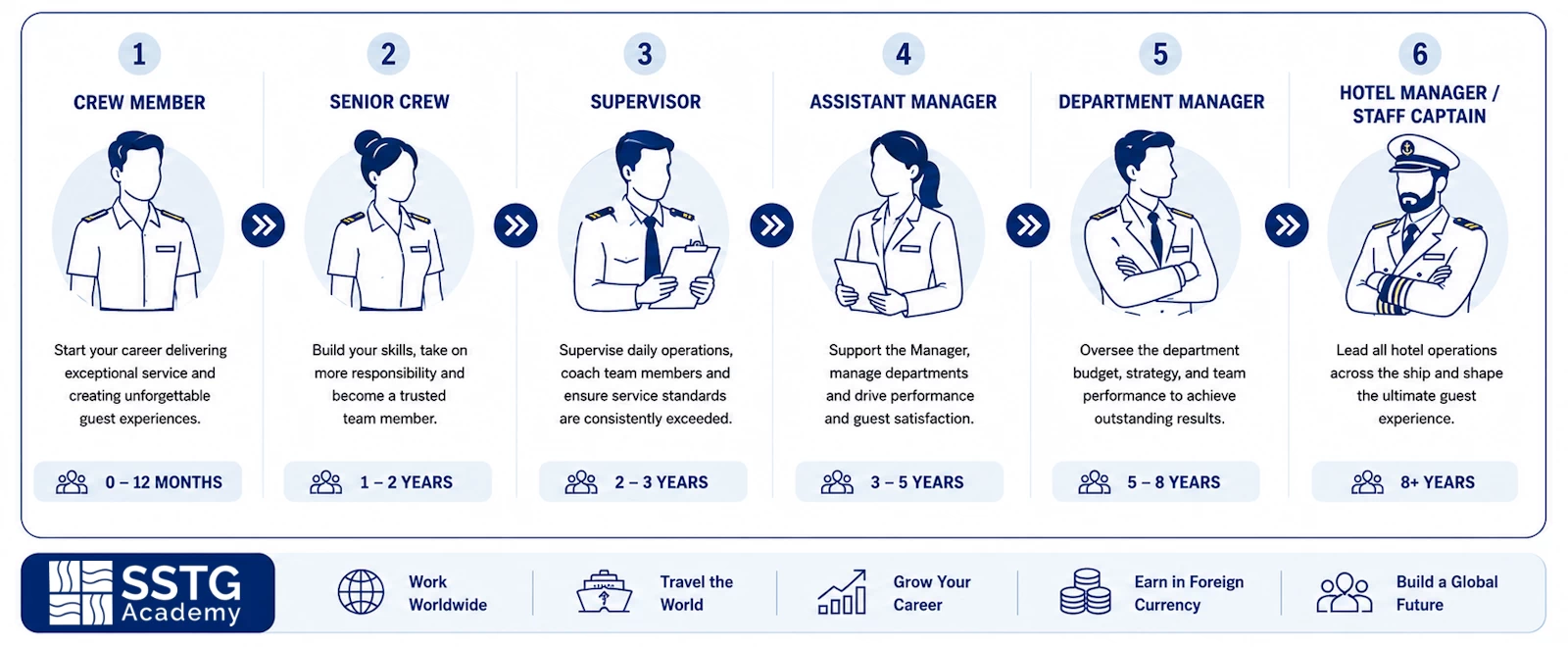
Cruise Ship Career Ladder
Your Journey. Your Growth. Your Future at Sea
Additional Services
- Cruise line-specific CV optimisation
- Video interview preparation (cruise lines use video screening extensively)
- Recruitment partner introductions
- wContract negotiation guidance
- Alumni network access
- Lunch during training days
Useful Tips
- Work hard and show initiative — Your attitude, reliability and willingness to learn can help you build a strong reputation and progress in your career.
- Be punctual and prepared — Cruise operations depend on teams working to schedules, so being on time and ready for your duties is essential.
- Be adaptable — Working on a cruise ship means living and working with people from different cultures and adapting to changing situations.
- Communicate professionally — Good communication and teamwork are essential when working with passengers and colleagues from around the world.
- Stay organised — Cruise operations involve many departments, schedules and responsibilities. Good organisation helps you manage your duties effectively.
- Keep learning — Take opportunities to develop new skills and understand the different career paths available onboard.
Invest in your Future
Payment Options
- Option #1 - Full upfront booking and payment – You Save as above.
- Option #2 - We can structure a deposit + Monthly installments; some discount applies.
- Option #3 - We can structure a deposit + Quarterly installments; some discount applies.
Loan Calculator
Ready to Launch
Take your first step towards your international career. Contact us and a career consultant will get back to you. All inquiries are responded to during regular business hours (Mon-Fri).
Your contact information is only used for the purpose intended and in accordance with our privacy policy.
Frequently Asked Questions
Is this training safe for my child or me?
Safety is a fundamental part of working at sea. Cruise ships operate under international maritime regulations and safety management requirements. Students receive training in areas such as fire safety, personal survival, first aid, security and emergency procedures, depending on the programme. The aim is to help them understand how to respond safely and effectively in an emergency.
What if they don’t get a job after completing the training?
Completing the required training and certifications does not guarantee employment. However, having the appropriate qualifications can help candidates prepare for cruise and maritime employment opportunities. Career Guidance can also assist students with understanding their career options and preparing for the recruitment process.
How long are cruise contracts?
Contract lengths and leave periods vary depending on the cruise line, position and employment contract. Cruise roles can involve extended periods at sea and may include scheduled leave between contracts. Students should confirm the specific working schedule and contract terms with the employer before accepting a position.
Can they work locally too?
Yes. Depending on their qualifications, experience and the requirements of the employer, students may also explore opportunities in coastal hospitality, charter operations, ferry services, offshore support and other maritime environments.
Are accommodation and meals provided?
Some cruise and maritime contracts include onboard accommodation and meals, but this depends on the employer and employment contract. Students should always confirm what is included before accepting a position.
Package – Terms & Conditions
- Up-front payment is required to qualify for the saving.
- Once courses are booked, our refund policy applies.
- You have six months from the date of payment/booking to complete the courses included in the promotion.
- Courses can be booked and completed at any time during your 6-month validity period; consecutive course bookings are not required.
- Contact our Career Guidance if you are unsure of anything.